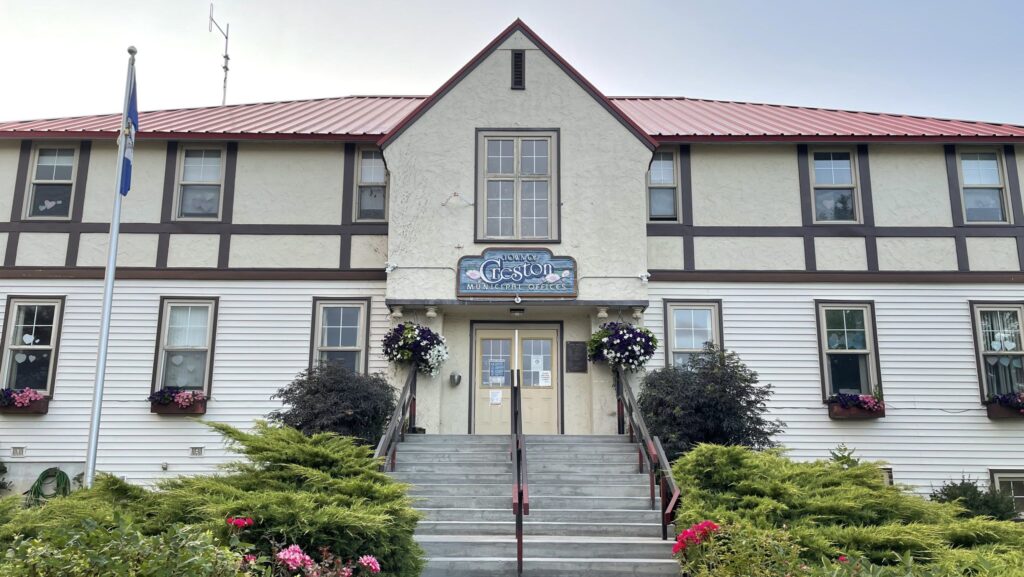
The town of Creston is moving forward with plans to extend its FireSmart program, with council voting in favour of applying for $400,000 in provincial funding to continue the work for another two years.
The funds would come from B.C.’s Community Resiliency and Investment program, administered through the Union of B.C. Municipalities.
The program was rolled out locally in 2024. Town staff told council on Tuesday, Dec. 2, it’s been steadily expanding.
In 2025, the program saw 43 homes and two essential care homes assessed. Fuel management prescriptions were also developed, and 12 rebates equalling $36,170 were delivered.
The town spent about $199,200 on FireSmart activities between August 2024 and October 2025.
Councillors spoke in favour of securing a two-year funding commitment, emphasizing how the program is effective and increasingly important.
“As the climate is starting to change more and we’re getting drier summers, it’s important to keep up with that,” said Councillor Megan Holland.
“I personally would prefer to go for a two-year program. It just allows us to really make it more how we’d want to see it in the future.”
Councillor Keith Baldwin agreed with Holland’s comments on the importance of the program, though he questioned whether it could become more proactive.
“It always seemed odd that you kind of had to wait for an individual property owner to go, I want to have my property assessed, rather than being a little bit more proactive,” he said.
“Because there could be a house or a property with just wall-to-wall incendiary devices, basically. But unless they ask for involvement, the FireSmart program is kind of kind of lame.”
Baldwin pressed staff on whether the town could take a more assertive approach, noting the voluntary nature of the program can limit its impact.
He asked whether there’s a way the program could identify high-risk properties that haven’t opted in.
“Is there any chance of putting more teeth into the program? You could be living next door to a property that is a risk, but you as the owner have no influence in pointing out that risk. So, have we done an inventory of areas that are potentially threats?”
CAO Michael Moore said the town can’t force homeowners to participate, nor can it enter private property to enforce FireSmart standards.
Instead, he said the program relies on public outreach and education to encourage participation.
“FireSmart’s very voluntary and there is no way that you, through any form of legislation, would you be able to enter somebody’s property and ask them to do anything,” said Moore.
“If there is what we would consider community risk of significance, certainly there is some tools that are provided to us under the Community Charter.”
Councillors also raised questions on the rebate program, asking if there are other funding opportunities that could increase the amount homeowners are eligible for.
“That might address situations where some properties may be like, this is, yeah, great. I want my property safe but I can’t afford to change the type of shed that I have or the location where it is or those types of things,” said Councillor Carolyn Hawton.
“Short answer, no. Not for residential,” answered Moore, adding that municipalities can adjust local rebate structures if demand grows.
Councillors voted in favour of applying for the two-year funding stream. If approved, the $400,000 would be split evenly between 2026 and 2027.
Each year the funds would pay for a FireSmart co-ordinator, emergency management support, public education initiatives and materials, community events, staff training, operational costs and $50,000 in homeowner rebates.
Want to get your business noticed? Have you considered advertising through your local radio station? Speak to one of our sales agents and find out how radio advertising can boost your business today. Call 250-365-7600 or email Vista Radio.
The post Creston seeks $400K to extend FireSmart program appeared first on My Creston Now.
This post was originally published on My Creston Now






































 |
|